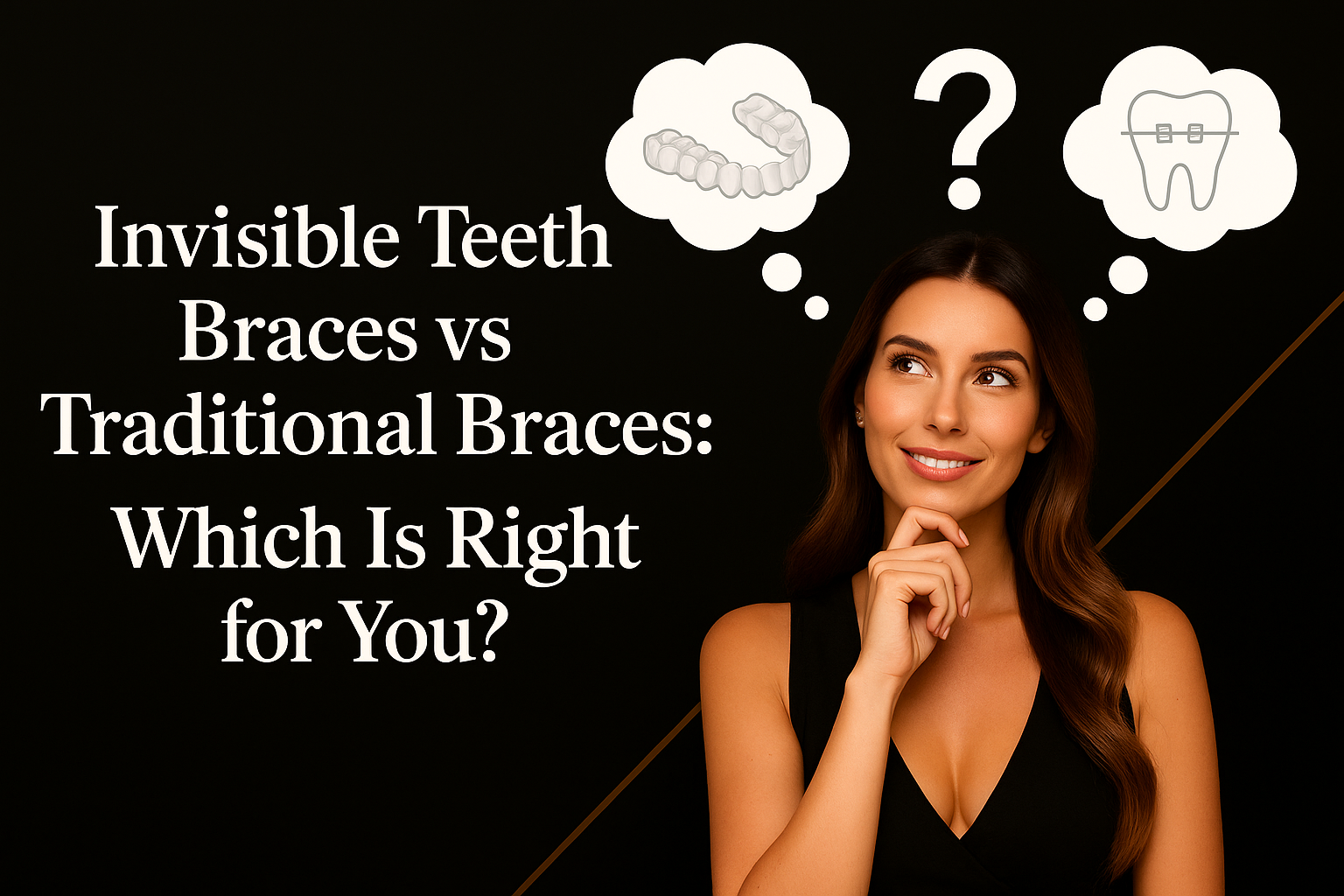
“Invisible braces” can mean clear aligners, tooth-coloured ceramic braces or braces fitted behind the teeth; no option is completely invisible and not every option suits every bite. Clear aligners are removable and depend on consistent wear. Fixed braces work continuously and can be easier for children or teens who may forget trays. The right choice depends on the bite, tooth movement required, age, oral health, cooperation and whether specialist orthodontic input is needed.
Invisible braces versus traditional braces at a glance
| Question | Clear aligners | Metal or ceramic fixed braces |
|---|---|---|
| Can they be removed? | Yes, for meals, most drinks and cleaning; this also means the patient must remember to wear them. | No. Brackets stay attached and keep working between visits. |
| How visible are they? | Clear but not invisible; attachments may be visible. | Metal braces are visible. Ceramic braces are less noticeable but not invisible. |
| Who controls daily wear? | The patient. Consistent prescribed wear is essential. | The appliance is fixed, although elastics and cleaning still require cooperation. |
| Eating and cleaning | Remove aligners for food and clean teeth before replacing them. | Food can collect around brackets, so careful brushing and interdental cleaning are essential. |
| What can be treated? | Suitable for selected tooth and bite movements after assessment. | May offer different control for complex movements; suitability still requires diagnosis. |
| Retention | Both approaches normally require retainers because teeth can move after treatment. | |
The Australian Dental Association explains that braces and clear aligners are both teeth-straightening options, that aligners are clear rather than invisible, and that suitability must be assessed by a dentist or orthodontist.1 Healthdirect similarly notes that clear aligner suitability depends on the amount of correction required and that many general dentists provide some orthodontic treatments while orthodontists are specialist dentists with additional training.2
Which option may suit a child or teenager?
For a responsible teen who can wear and safely store trays as prescribed, clear aligners may support easier eating, sport and brushing. For a child or teen who is likely to remove, lose or under-wear trays, fixed braces may be more predictable because they remain attached. Orthodontics Australia notes that clear aligners require substantial daily wear and careful storage, and that lost, broken or inconsistently worn aligners can compromise progress.3
An early assessment does not automatically mean immediate treatment. The ADA recommends an orthodontic assessment for children between about 7 and 10 years of age and states that all adult teeth do not need to be present before assessment.1 Some children only need monitoring; others may benefit from intervention or referral. Parents should be shown what problem is being monitored and why a particular timing is recommended.
When specialist orthodontic input is important
Dr Nick is a general/family dentist who offers braces assessment and selected orthodontic care; he is not an orthodontist or dental specialist. Referral or shared care may be appropriate for severe jaw discrepancy, complex tooth movement, impacted teeth, significant growth concerns, surgical planning, uncertainty about diagnosis or when a patient wants a specialist opinion. This distinction is explained before treatment rather than hidden in marketing language.
What should be checked before braces or aligners?
- Tooth decay, gum inflammation and oral-hygiene readiness.
- The way the upper and lower teeth meet, not only whether the front teeth look straight.
- Jaw growth, missing or impacted teeth and relevant habits.
- How much cooperation removable aligners or elastics will require.
- Sport, musical instruments, school routines and dietary habits.
- Expected reviews, retainers and long-term maintenance.
- Whether another dentist or specialist should contribute to the plan.
The ADA advises against unsupervised direct-to-consumer or do-it-yourself orthodontic treatment because assessment and ongoing professional supervision are important for protecting the teeth, gums and jaw joints.1
What about ceramic braces?
Ceramic braces use tooth-coloured or white brackets on the front of the teeth. They remain fixed like metal braces and may be less noticeable, but they are not invisible. The dentist or orthodontist should discuss suitability, cleaning, breakage or wear concerns, treatment mechanics and whether metal braces or aligners would be more practical for the individual patient.
How long does treatment take?
No website can give an accurate duration without diagnosis. Healthdirect states that braces and retainers commonly involve a long treatment period and gives a general range of one to three years for tooth straightening, while individual treatment may be shorter or longer.2 Complexity, growth, broken appliances, missed visits, oral hygiene, aligner wear and elastics can all affect timing.
Dr Nick’s view: choose the option the family can maintain
“The most discreet appliance is not automatically the best appliance. I consider the bite, the movement required, oral hygiene and whether the child or teen will realistically manage removable trays. Parents should understand why a plan is recommended, what cooperation it needs and when specialist advice would be useful.”
Parents can book a braces assessment or call (02) 7256 4979. Explore braces for children and teens in Liverpool, braces options in Blacktown, or clear aligner information. Contact us for pricing after examination and a written treatment plan.
Invisible braces questions
Are clear aligners actually invisible?
No. They are made from clear plastic and can be less noticeable than metal braces, but trays and tooth-coloured attachments can still be seen.
Are clear aligners better for every teenager?
No. They require consistent wear, cleaning and safe storage. Fixed braces may be more practical where removable-tray cooperation is uncertain or different tooth movements are required.
Can a general dentist provide braces or aligners?
Many general dentists provide selected orthodontic treatment. An orthodontist is a dental specialist with additional training. The clinician should explain their role and recommend referral or shared care where appropriate.
Sources: Australian Dental Association: Teeth straightening and braces; Healthdirect Australia: Dental braces and retainers; Orthodontics Australia: Children and clear aligners.
Introduction
Choosing between Invisible Teeth Braces vs Traditional Braces Sydney is one of the most common decisions for patients considering orthodontic treatment. Both options straighten teeth effectively, but they differ in appearance, comfort, cost, and lifestyle impact.
In Sydney, more patients are opting for invisible braces (clear aligners like Invisalign) for their discreet look, while traditional braces remain popular for complex cases. This guide compares both options so you can decide which treatment best fits your needs.
What Are Traditional Braces?
Traditional braces use metal or ceramic brackets fixed to the teeth with wires and elastics to gradually move teeth into alignment.
Pros of Traditional Braces:
- Effective for severe misalignment and complex bite issues
- Often more affordable than invisible braces
- Multiple types available (metal, ceramic, lingual)
Cons of Traditional Braces:
- Noticeable appearance
- Food restrictions (avoid sticky and hard foods)
- Possible discomfort or irritation from brackets and wires
- Require regular orthodontic adjustments
What Are Invisible Teeth Braces?
Invisible braces (clear aligners such as Invisalign) are transparent trays custom-made to fit over the teeth. They are removable and gradually shift teeth into place.
Pros of Invisible Braces:
- Nearly invisible appearance
- Removable for eating, brushing, and flossing
- Generally more comfortable with no brackets or wires
- Shorter, simpler adjustment visits
Cons of Invisible Braces:
- Less effective for severe or complex cases
- Must be worn 20–22 hours daily for best results
- Typically higher cost than traditional braces
- New aligners every 1–2 weeks require discipline
For More Info visit : Invisalign
Key Differences – Invisible Teeth Braces vs Traditional Braces Sydney
| Feature | Traditional Braces | Invisible Braces (Clear Aligners) |
|---|---|---|
| Appearance | Visible (metal/ceramic) | Nearly invisible |
| Treatment Time | 18–36 months (case dependent) | 12–24 months (mild to moderate) |
| Comfort | Possible irritation from brackets/wires | Smooth trays, generally more comfortable |
| Cost (Sydney) | $6,000 – $9,000 | $7,500 – $11,000 |
| Removable? | No | Yes |
| Best For | Complex misalignments & bite issues | Mild to moderate misalignments |
Cost of Invisible Teeth Braces vs Traditional Braces Sydney
- Traditional Braces: $6,000 – $9,000
- Ceramic Braces: $7,000 – $10,000
- Lingual Braces: $9,000 – $12,000
- Invisible Braces (Clear Aligners): $7,500 – $11,000
💡 Tip: Many Sydney orthodontists offer flexible payment plans and interest-free financing.
Treatment Time – Invisible Teeth Braces vs Traditional Braces Sydney
Traditional braces may take 18–36 months depending on case severity. Invisible braces often finish in 12–24 months for mild to moderate issues. For complex cases (severe crowding or bite problems), traditional braces are usually faster and more predictable.
Comfort and Lifestyle Considerations
- Traditional Braces: May cause mouth sores or irritation; dietary restrictions apply.
- Invisible Braces: Smooth plastic aligners are more comfortable, removable for meals, and easier to clean.
FAQs – Invisible Braces vs Traditional Braces
Q1: Which braces are better for adults?
Invisible braces are popular among adults due to their discreet look and convenience.
Q2: Are invisible braces as effective as traditional braces?
Yes, for mild to moderate misalignments. Severe cases often require traditional braces.
Q3: Can children use invisible braces?
Yes, but compliance is crucial since aligners must be worn 20–22 hours daily.
Q4: Which option is more painful?
Both cause mild pressure during adjustments, but aligners are usually more comfortable overall.
Q5: Do both options require retainers afterward?
Yes. Retainers are needed after treatment to maintain your new smile.
Conclusion & Call-to-Action
Invisible Teeth Braces vs Traditional Braces Sydney: Which Should You Choose?
Both invisible and traditional braces can deliver great results. If you value discretion and convenience, invisible braces are a strong choice. For complex cases requiring stronger correction, traditional braces remain the most effective option.
👉 Book a consultation with a Sydney orthodontist today to discuss whether Invisible Teeth Braces vs Traditional Braces Sydney is the right choice for your smile.